

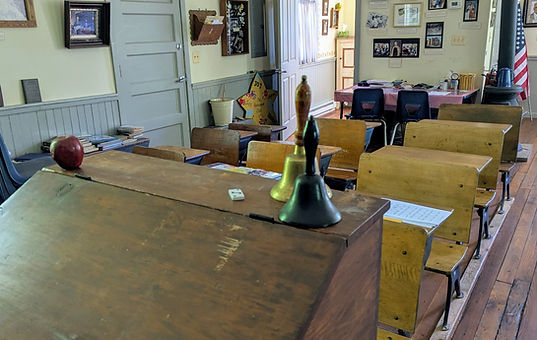
Planks on the floor. Rough walls without any paint. Books with pages torn out by white kids who owned them first. A bunch of kids ages six to twelve crammed into a room with one underpaid teacher who rode the train from Baltimore each day. A dipper they passed around with water from the nearby Dorsey family stream. Heat from the coal stove that sometimes coated the windows with soot and could never quite get the room warm enough on windy days.
Memory of Warren Dorsey, conveyed via local author, Jack White, in the 2014 book, In Carrie’s Footprints: The Long Walk of Warren Dorsey

Asa Hepner, original owner of the land used for the schoolhouse, seen here in 1910. Supplement to the Democratic Advocate, Westminster, MD 21, October 1910. Gate House Museum Collection.
In 2024, in cooperation with the Downtown Sykesville Connection's Justice, Equity, Diversity, and Inclusion (JEDI) group, the Gate House Museum concentrated research on expanding our understanding of Sykesville's historically black community along Oklahoma Avenue and Schoolhouse Road. This information on this page is the result of this and ongoing research to better understand the particular experiences of rural one room schools, like the Sykesville Historic Colored Schoolhouse. The material on this page was on display at the schoolhouse during the summer of 2025.
Sykesville Colored Schoolhouse
1904-1938
Starting A School
In 1870, 86% of Maryland’s Black population were unschooled. Rural counties relied on child labor on farms, and struggled to retain enough students for the state to help fund qualified teachers and keep schools open. The state of Maryland mandated access to public education beginning in 1872, and while Sykesville had a school for white children on Main Street as early as the 1877, local children of color were haphazardly educated by churches, or were sent to Howard or Baltimore County schools for elementary education.
In 1872, the Maryland General Assembly mandated that each voting district should have at least one school for white children and another for black children. Lacking funding, teachers, and organization for building schools of any kind, the Carroll County School Board sent Sykesville’s local children of color to attend a school located along River Road. To attend this school, families had to pay out-of-county tuition, which was not covered by Carroll County. In the 1880s, Howard County closed the River Road school, as only Carroll County students were in attendance. Families in the “Okalahoma Settlement”--a growing community of color parallel to Sykesville’s Main Street banded together to petition the Carroll County School Board to establish a Black schoolhouse in Freedom District, specifically for Sykesville’s children.
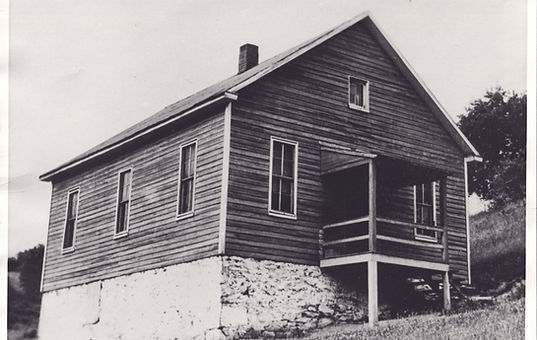
On July 30, 1903, Asa Hepner, a local businessman and landlord of the adjacent black community, sold the land and a nearby well pump for $134.00 to the Carroll County Board of School Commissioners for use as a segregated schoolhouse. The Sykesville Colored Schoolhouse was the 13th school built for students of color in Carroll County. Unlike other segregated schools in Maryland, this schoolhouse was neither a Freedmen’s Bureau school nor a Julius Rosenwald School. Lacking special funding from those organizations, the Sykesville Colored Schoolhouse received funding from the community and, to some degree, the County.
It took several more months for the School Board to acquire secondhand desks, supplies, and a teacher for the school.
The school opened mid-term, on Monday, January 4, 1904.


Teachers
At the start of the 1900s, Carroll County Public Schools were responsible for vetting teachers for training and experience before granting them licenses to teach in county schools. However, rural schoolteachers, and especially black schoolteachers were in short supply. Until 1956, teachers in Carroll County were always the same race as their students. Many who taught here at the Sykesville Colored Schoolhouse and at other segregated schools nearby held only second-class teaching certificates. Teachers of all colors were encouraged to advance their certificates as they worked, thereby helping alleviate the teacher shortages.
Many of Sykesville's teachers traveled from as far as Baltimore, arriving tired and overwhelmed by as many as sixty children in five to seven grades, and a student absentee rate of more than 50%.
Student Experience
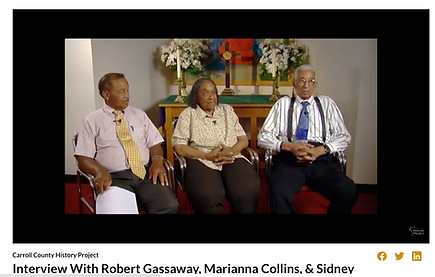
In the early 2000s, the Historical Society of Carroll County (in tandem with the Carroll Media Center) collected a series of interviews of Black experiences throughout the county. We encourage you to click on the names below to view these and the recordings of Sykesville residents to hear first-hand about life in this classroom.
William Hudson (b. 1922, student c. 1929)
Marianna Collins (student c. 1930s)
The experience of Warren Dorsey (student c. 1930s) at the schoolhouse was extensively documented in the book, In Carrie's Footsteps: The Long Walk of Warren Dorsey. He additionally sat fora number of interviews at the schoolhouse and Gate House Museum, as well as for the Community Media Center. An interview conducted near Dorsey's 100th birthday can be found here.
Local videographer, Richard Taylor has also graciously granted permission to share his videos of several Historic Schoolhouse alumni presentations over the years.

Putting Stories into Context
In the fall of 1916, Maryland implemented its first compulsory education law. For more than a decade, Carroll County, whose farming communities relied on the labor of children, had tried to delay its implementation. Within a year, average attendance at both white and black schools rose from roughly 50% to 80% or more. These initial rules applied to ages 8-12, and later expanded to age 14, with partial-year exemptions for working children.
You can find more information on training for black teachers at these outside sources:
Towson University Library
Bowie State University Library
Hathi Trust: Reports of the State Board of Education


The Norris Home 1939-1988
This is a paragraph. When Carroll County consolidated this school's population into Johnsville School, Elizabeth Hepner purchased the house for $100 and converted it into a four-room house.
The Norris family moved into the building in 1939, and continued to use it as a home for several decades.
(photographs at left: top: unidentified woman in the kitchen area of the building. Bottom: Owen "Hankie" Norris in front of the building as a child. Colored School Project Collection, 014.04-29)

Schoolhouse building seen in 1997 in substantial disrepair. Gate House Museum Collection.

The Maryland Millennium Celebration, 2000 at the Schoolhouse. Richard Dixon, Eugene Johnson, Mae Whiten, William Donald Scheffer are seen here. Gate House Museum Collection, ID: 016.04-4
Saving the Schoolhouse
1988-2005
In the 1980s, Sykesville struggled to maintain its Historic District designation. While there had been some interest in renovating the schoolhouse at the time of the installation of the Schoolhouse Road Apartments, lack of funding made this a non-starter.
Town Councilman, Eugene Johnson recognized the importance of the Historic Colored Schoolhouse to the Sykesville community. After years of effort alongside James Dorsey, Earl Norris, and others the Town efforts were made to restore the schoolhouse
By the 1990s, the schoolhouse had fallen into substantial disrepair (see photo at left, dated 1997). The Maryland Millenium Celebration afforded the opportunity and funding for projects like the restoration of the schoolhouse.
The Restored Schoolhouse
2006-Present
(Photo: The Norris Family, whose children lived here in the 1940s, Owen (Hankie), Laura, and Hayes, are seen here as adults revisiting the Schoolhouse at the time of its designation as a National Treasure. Black Schoolhouse Project Archive, 2000.)
The Obama administration (2009-2017) brought new attention to Black history sites throughout the Nation, including the schoolhouse.