Sykesville's Mayors
From 2026 through 2027, Gate House staff will be researching our town's mayors to better understand how they shaped Sykesville. Look for a new person to be added roughly every three weeks!

1904-1907, 1915-1916
Edwin Mellor
Edwin Mellor was Sykesville's first Mayor. He was chosen for his continuous role in the community in business as well as socially. Mellor served three contiguous one-year terms as well as a second partial stretch during World War I until his sudden death in 1916.
Under Mellor, the Town organized its first volunteer fire department (in which, Mellor served), expanded the Sykesville National Bank (on which he was a director), and made plans to revise the Town's original charter.
In addition to his political decisions, the physical face of Main Street was shaped by construction of the Mellor and Sons Store, which, at the time, was the largest department store between Frederick and Baltimore.
Read more about his life here, or click on the links above for more information.

1907
Asa Hepner
Asa Hepner had both competed and collaborated in business and politics with Sykesville’s first Mayor, Edwin Mellor. Hepner was a Methodist and a republican, active in social and political organizations.
Hepner held a variety of jobs in Sykesville, from his teenage years as an apprentice brick molder, to his 1890s mercantile work, a later clay manufacturing business alongside Wade H.D. Warfield, and numerous investments in other enterprises including running a music store, serving among the directors of the Sykesville National Bank in 1907, serving on the Sykesville School Board for eight years, and becoming one of the original incorporators of the Sykesville Realty and Investment Company. Hepner also served sixteen years as the Sykesville postmaster from 1897-1914.
In the spring of 1907, Hepner was nominated for the position of Sykesville’s mayor. In the Westminster newspaper, The Democratic Advocate, the paper states that, “Under the new regime, the town is promised a new charter and street improvements which the rapid strides of the last few years demand.” One of the first actions was to hire a night watchman for the town.
This progress was to be short-lived, as in late summer, the federal Post Office Department insisted that Hepner had a conflict of interest and needed to give up either his position as postmaster, or his position as Mayor. Hepner resigned as mayor, and Wade H.D. Warfield (president of the council) was elected by council to fill the position of Mayor.
Read more about his life here, or click on the links above for more information.

1907-1908 (Completing Term of Asa Hepner, and serving an additional term)
Wade H.D. Warfield
By his first term in office as Mayor, Wade H.D. Warfield owned a substantial amount of property within the limits of Sykesville. This well-known young, progressive, democrat businessman expanded businesses and buildings throughout the late 1880s when he was still in his early 20s.
In 1900, At the age of 35, in connection with his agricultural ventures, he was appointed to serve on the Baltimore and Ohio Railroad’s Dairymen’s Association, overseeing the trade of all dairy products on the B&O Main Line--a trade that greatly impacted early Sykesville.
Warfield spearheaded the formation of the Sykesville National Bank—Sykesville's first bank—which opened the following year with Warfield as the President of the board.
In 1904, when the Town of Sykesville incorporated, Warfield was named Town Council President. He also served as the president of the newly founded Sykesville Volunteer fire company, helping to finance the original engine for the organization.
In 1907, a conflict of interest between elected Mayor Hepner’s occupation as Post Master for the federal government and his role as Mayor caused Hepner to resign, and Town Council to appoint then-councilman Warfield to complete the term. Warfield’s most notable achievement as mayor was having arranged for creation of a fund to pave and maintain Sykesville’s streets. He won the popular election the following year to reprise his role as mayor.
Warfield continued to support the interest of Sykesville and its citizens in state politics, in particular promoting the inaction of prohibition and universal women’s suffrage. He served as a Maryland State Senator in 1915 on a platform of lower taxes and more efficient administration, at the same time as he incorporated his large milling operation under the Maryland Milling and Supply Company--then the largest industry of its kind in the state. The stress of his business and loss of a reelection campaign caused an attack which took him out of the public eye for most of the winter of 1919.
In 1922, Warfield planned to run for Congress, however, illness struck again, deeply impacting his businesses. Already having suffered several fires in his personal properties and businesses in the last couple years, Warfield cited his health for selling his home, his farm, the college which bore his name, the rest of his holdings in Marriottsville, and several other small holdings. He also gave up many of his board positions at this time. Evidence suggests that he suffered at least one and probably two strokes between 1922 and his death in 1935.
His family home, Chihuahua (Raincliffe), today is a recognized Maryland Historic Trust site, near Freedom Park, while the ruins of his personal home, Groveland, can still be found today in Sykesville. Additionally, he briefly owned the entire town of Marriottsville (from 1909-1917).
Read more about his life here, or click on the links above for more information.

1909-1915
Dr. Daniel Sprecher
Daniel B. Sprecher arrived in Sykesville from Ellicott City in 1881, immediately after receiving his doctorate. Dr. Sprecher was a democrat politically, and very active in the Sykesville community—especially as a leader of the Springfield Presbyterian church. Dr. Sprecher was elected mayor for six consecutive one-year terms, many of which with no opposition.
As a rural doctor, Sprecher is noted as having served all colors and socioeconomic status of persons in the area. Sprecher also served as a surgeon for the Baltimore and Ohio Railroad for over twenty years of his fifty-three years in practice.
Read more about his life here, or click on the links above for more information.

1917-1918
George Schrade
George Schrade was born in Pennsylvania to German immigrant parents. As a young man, Schrade was a mechanic and the foreman of the L.P. Shultz and Co. Machine shop in Sykesville. For most of his career, Schrade ran his own blacksmith shop, but Schrade was also an early shareholder/director of the Sykesville Perpetual Building Association, joining on or before 1895 and serving as president on or before 1907 for a total term of about 25 years. Schrade also served as a director of the newly-established First National Bank of Sykesville (in operation 1907-1913).
The Building Association was formed in 1880 in Sykesville, originally serving as a project-by-project locally-funded loan entity for homes and businesses. Decades before the establishment of Sykesville’s first bank, this organization made the construction of Main Street, and its surrounding communities, possible.
Read more about his life here, or click on the links above for more information.

1918-1926
Robert L. Swain
Dr. Robert Lee Swain came to Sykesville from Delaware. Swain attained his professional training at University of Maryland's School of Pharmacy, receiving his degree in 1909. Like his father in law, Dr. Daniel Sprecher (also a Sykesville Mayor), Robert Swain served multiple terms of office as mayor, largely unopposed.
Around 1910, Weer became managed two Sykesville Pharmacies and became a proprietor of Swain’s Drug Store at 7606 Main Street from 1911 through the 1920s. In 1920, Swain was appointed to the Maryland State Board of Pharmacy, and was one of only two individuals to pass the exam for Maryland Deputy Drug Commissioner in 1922, serving in this position through at least 1929.
Along with several other notable Sykesville citizens, Swain was involved in the creation of the Freedom District Democratic Club, in which he served as secretary-treasurer at its founding in 1919 alongside his former business partner and club president, Millard Weer. The club espoused the idea of getting rid of republican control in Carroll County, improving roads, and supporting “social betterments and any matter of community welfare.”
During World War I, Swain served as the Salvation Army County Treasurer, organizing fundraising efforts to support soldiers and affected communities.
In 1922, Swain further diversified, serving as a director of the Sykesville Manufacturing Company, as it began efforts to incorporate for the purpose of opening a shirt manufacturing operation in Sykesville near the Sykesville Train Station.

1926-1929
Irvin E. Buckingham
Irvin Hugh Elderdice Buckingham was from nearby Taylorsville, where he lived and attended school through the 7th grade (the highest grade offered at most rural schools in Carroll County), but moved to Sykesville around 1903 in the service of the Baltimore and Ohio railroad, where he lived with his wife, Charlotte Shipley (a native of Mount Airy). After his service with the B&O, he briefly served as a furniture salesman around 1910 before entering the insurance industry around 1916. For most of his career Irvin E. Buckingham was an insurance agent who operated his business out of his home, 7557 Main Street.
Read more about his life here, or click on the links above for more information.

1929-1935
Millard H. Weer
Millard Hopkins Weer (1885-1967) was a lifelong resident of Sykesville, noted democrat, and like his predecessors, served many roles in the Town.
Weer had an 8th grade education (the highest level locally attainable in Sykesville) with which he served in the office of the purchasing agent of the Baltimore and Ohio Railroad. Because of that role, in 1907, Weer became the cashier of the new First National Bank of Sykesville.
Weer was also the Postmaster of Sykesville 1914 until 1922, and ran the Weer Insurance Company from the 1920s until 1966.
At the time of his term of office as Mayor, the Mayor's office was located at 7565 Main Street. He was the first of Sykesville's Mayors to hold a term of two years instead of one year.
Read more about his life here, or click on the links above for more information.

1935-1941
Dr. J. B. Koerner
John Bernard Koerner (1889-1960) came to Sykesville from Baltimore County in 1910 for the summer, and returned a year later after completing veterinary school in Grand Rapids, Michigan.
In 1913, after a five year long-distance relationship by mail, Koerner married Marie A. Schwanebeck of Baltimore. They moved into a home at the corner of 2nd Avenue and Spout Hill Roads.
Koerner operated his veterinary practice in Sykesville from 1911 until 1957.
Koerner served three consecutive terms as Mayor from 1935-1941. The Sykesville Herald newspaper remarked that the results of the 1941 election marked “Probably the first time in local history the upper residential section of the town has more representation in municipal government than does the business section.”

1941-1945
R. Kenneth Barnes Sr.
Coming Soon
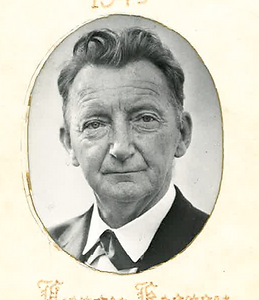
1945-1949, 1957-1963
LeRoy S. (Happy) Keeney
Coming Soon

1949-1957
R. Earle Carter
Coming Soon

1963-1967
Bernard C. McDougall
Sykesville's first Mayor to hold a four-year term (second term of office)
Coming Soon

1967-1972
Horace C. Jefferson
Coming Soon
1972-1973
Francis C. Manner
Coming Soon
1973-1977
William Brandenburg, Sr.
Coming Soon
1977-1981
Robert L. Killett
Coming Soon
1981-1993
Lloyd R. Helt Jr.
Coming Soon
Apply Today
This is a Paragraph. Click on "Edit Text" or double click on the text box to start editing the content.
123-456-7890